Begin in the browser for immediate board access
Chess in 3-D opens in a modern browser and supports both 2-D and 3-D board presentation. A local match against Stockfish can begin without registration, which makes the browser edition the lower-friction way to test the interface or play from a conventional screen.
The broader browser experience includes online rooms, ratings, history and replays for account-based play. Confirmed voice moves, spoken board narration and accessible controls provide alternatives to purely pointer-based interaction.
Enter Quest when the board should occupy space
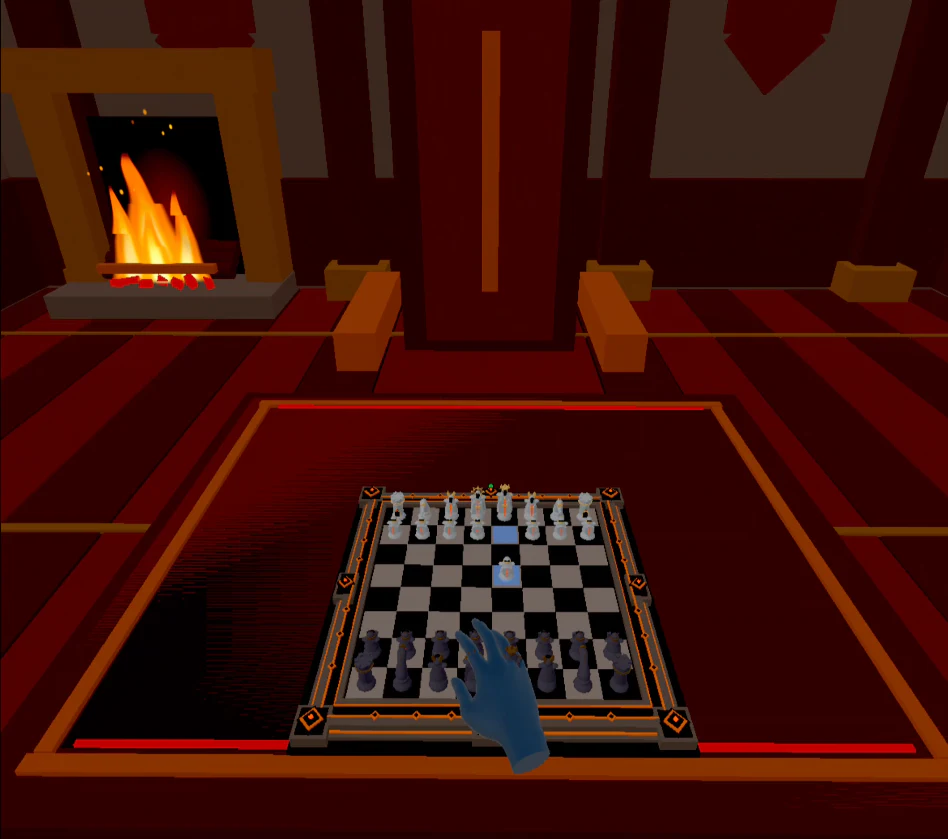
Chess VR presents the board as a dimensional object. In mixed reality it can sit on a real tabletop and be moved, rotated or resized. In virtual reality it appears inside an immersive study that reduces the visual presence of the physical room.
Pieces can be grasped with tracked hands or Touch controllers, while palm and wrist tools move interface actions closer to the player. Board placement and posture matter because the far rank must remain visible and reachable across a full game.
Match the presentation to the session
A 2-D browser board is compact and familiar. A 3-D browser board adds dimensional presentation without requiring a headset. Mixed reality adds physical placement while preserving room awareness. Virtual reality makes the surrounding study part of the focus.
Those are four distinct presentations of chess rather than a simple quality ladder. A short analysis session may favour a browser tab; a spatial, distraction-reduced session may favour the virtual study; and a board shared with the visible room may favour mixed reality.
- Browser 2-D: familiar board geometry and immediate access.
- Browser 3-D: dimensional pieces on a conventional display.
- Quest MR: a movable board placed in the real room.
- Quest VR: a spatial board inside an immersive study.
Choose by friction, input and focus
Choose Chess in 3-D when a browser link, mouse or touch access, voice support or a quick Stockfish game is the priority. Choose Chess VR when grasping pieces, positioning the board and controlling the surrounding environment are central to the experience.
Both routes can lead into deeper chess play. The deciding question is not whether chess needs three dimensions; it is which interface removes the most friction for the session you want right now.