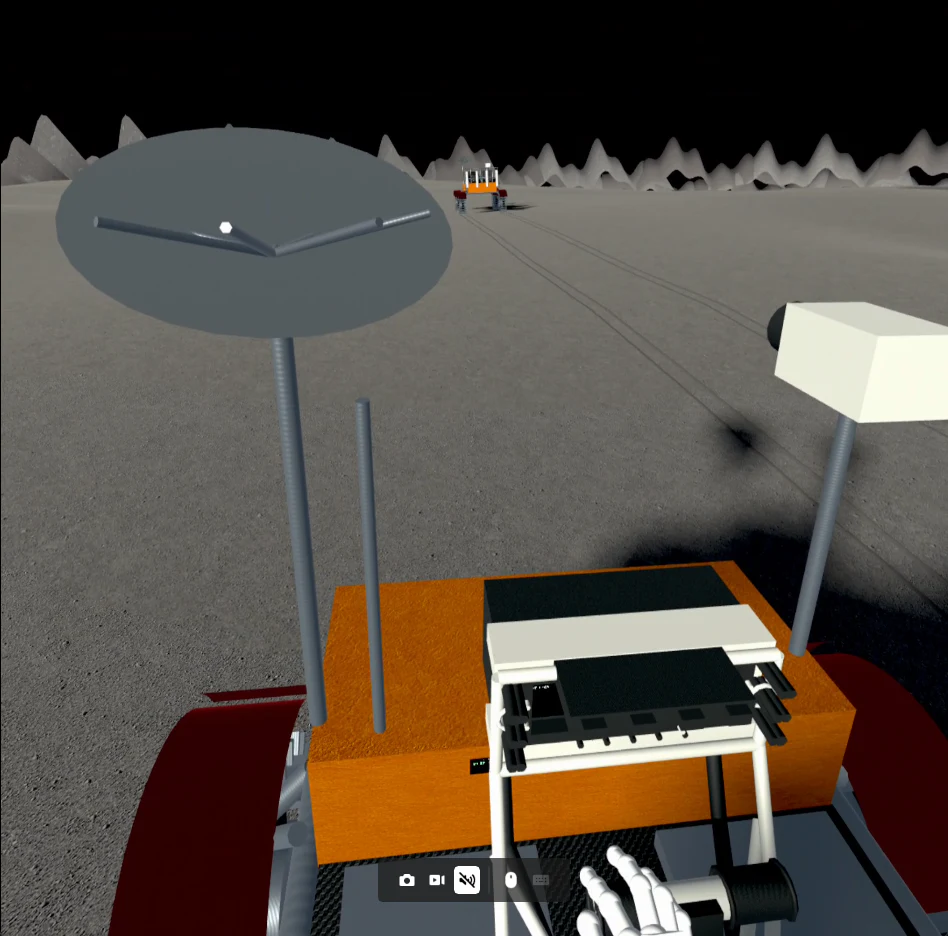
Prepare a seated cockpit
Sit in a stable chair with enough room for both hands to operate in front of the body. Re-centre the headset while facing straight ahead so the virtual instrument panel and Apollo-inspired T-handle align with a neutral posture. The goal is to reach the controls without leaning or twisting.
Keep the floor and the area beside the chair clear even though the game is seated. Controllers and real furniture can still collide when attention is on the lunar terrain.
Pick the input that stays predictable
The vehicle-control layer accepts Touch controllers, compatible gamepads and tracked hands. Touch controllers give reliable tracked motion and physical controls; a gamepad offers a familiar driving reference; hands make the cockpit feel direct. Automatic switching is designed to let those inputs feed the same rover controls.
For a first drive, use the method you can operate without looking down. Change inputs between runs rather than while learning a difficult slope.
Learn lunar terrain before chasing time
Free Ride is the natural starting mode. Use it to feel how low gravity changes braking, cresting and landing, and how four-wheel steering affects the rover’s path. Deterministic terrain means a crater or ridge can be approached again, making repeated lines useful practice rather than random luck.
Time Trial adds pace after basic control is comfortable. AI Duel adds another moving rover and more decision pressure. Safe recovery is available when a mistake leaves the vehicle in an unusable position.
- Free Ride: learn the rover and terrain.
- Time Trial: turn a known route into a measured run.
- AI Duel: manage the terrain while competing with another rover.
Use comfort tools early
Comfort profiles are most useful before discomfort develops. Start conservatively, keep the first session short and stop if the visual motion and physical body sensation begin to disagree. Conducted impact sound, haptics and lunar dust add useful feedback, but they should support rather than overpower the drive.
A good first session is not the fastest lap. It is the point where the cockpit feels aligned, the input is predictable and the next slope can be read before the rover reaches it.